Automated Dialog Replacement Guide for Modern Creators
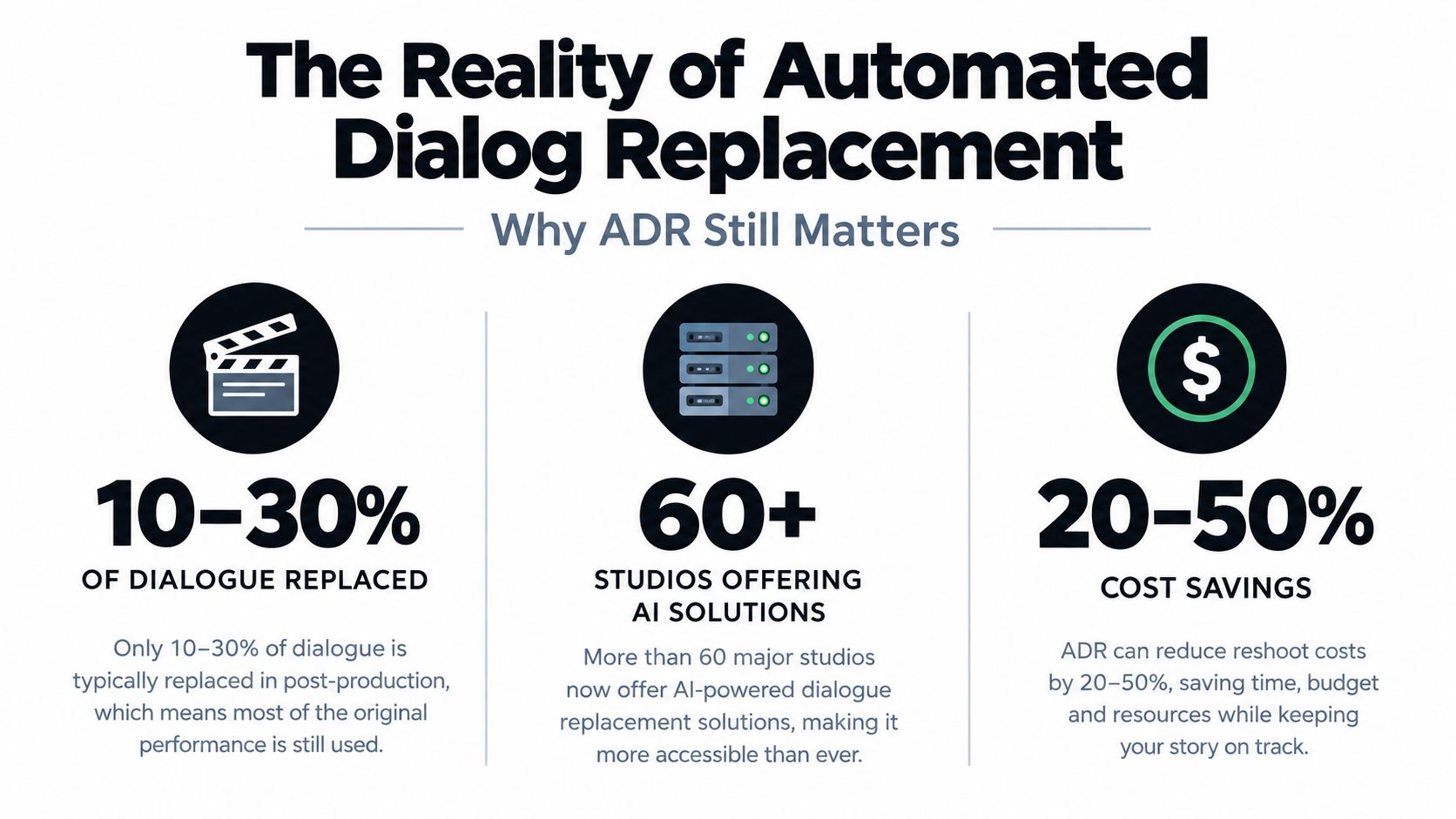
Approximately 10%–30% of dialogue in a typical film is replaced or supplemented through ADR. Automated dialog replacement matters because it can help editors repair damaged production sound, test timing, and prepare replacement performances without treating every problem as a full studio reshoot.
You've probably heard the problem before you've seen it. A scene looks perfect, but a passing truck swallows a key line, wind rattles the microphone, or a script change arrives after the actor has left the location. The editor then has to decide whether to rescue the original recording, cut around it, or recreate the dialogue while preserving the actor's timing, emotion, and acoustic perspective.
ADR, short for automated dialogue replacement, traditionally means recording dialogue after photography and synchronizing it to picture. In modern post-production, automation adds another layer. AI can help isolate speech, remove competing sounds, generate or adapt replacement audio, and check whether the result follows the visible performance. The craft still depends on editorial judgment, though. A clean waveform isn't enough if the new line feels detached from the room or the actor's face.
What Automated Dialog Replacement Looks Like in Practice
A dialogue editor receives a scene recorded beside a busy street. The actor's performance is strong, but a bus crosses the most important sentence. The take preserves the right breath, hesitation, and emotional turn, yet the words are not clear enough to carry the story. The editor must decide what to save and what to rebuild.
That decision sits behind the estimate that approximately 10%–30% of dialogue in a typical film is replaced or supplemented through ADR, according to this industry overview of ADR's role in film. The range varies with location conditions, genre, budget, and editorial choices. A production with clean recordings may retain most of its original dialogue. A technically difficult shoot may depend much more on post-synchronization.
Why production audio fails
Production sound can fail for several practical reasons:
- Environmental noise: Traffic, aircraft, rain, crowds, machinery, and wind compete with speech.
- Speech intelligibility: A line may be recorded but buried, clipped, muffled, or masked by another sound.
- Continuity problems: Microphone position or room character may change between takes.
- Late script changes: A revised line may need to fit an existing shot after filming ends.
Traditional ADR addresses these problems by having the actor reperform the line while watching the scene or following a cue track. Automated tools support the same workflow by reducing preparation and cleanup. For example, Isolate Audio can help separate dialogue from music, ambience, and incidental sounds before the editor evaluates a repair or replacement.
The practical sequence is straightforward: identify the damaged words, preserve usable production audio, prepare a replacement only where needed, then match timing and acoustic perspective. AI can handle repeatable separation and analysis, while the editor judges whether the voice still belongs in the room, matches the visible performance, and supports the scene's emotion.
Practical rule: Treat automated dialog replacement as a controlled post-production workflow. Performance, sync, perspective, and mixing decisions still require human judgment.
From Silent Cinema to AI-Driven Workflows
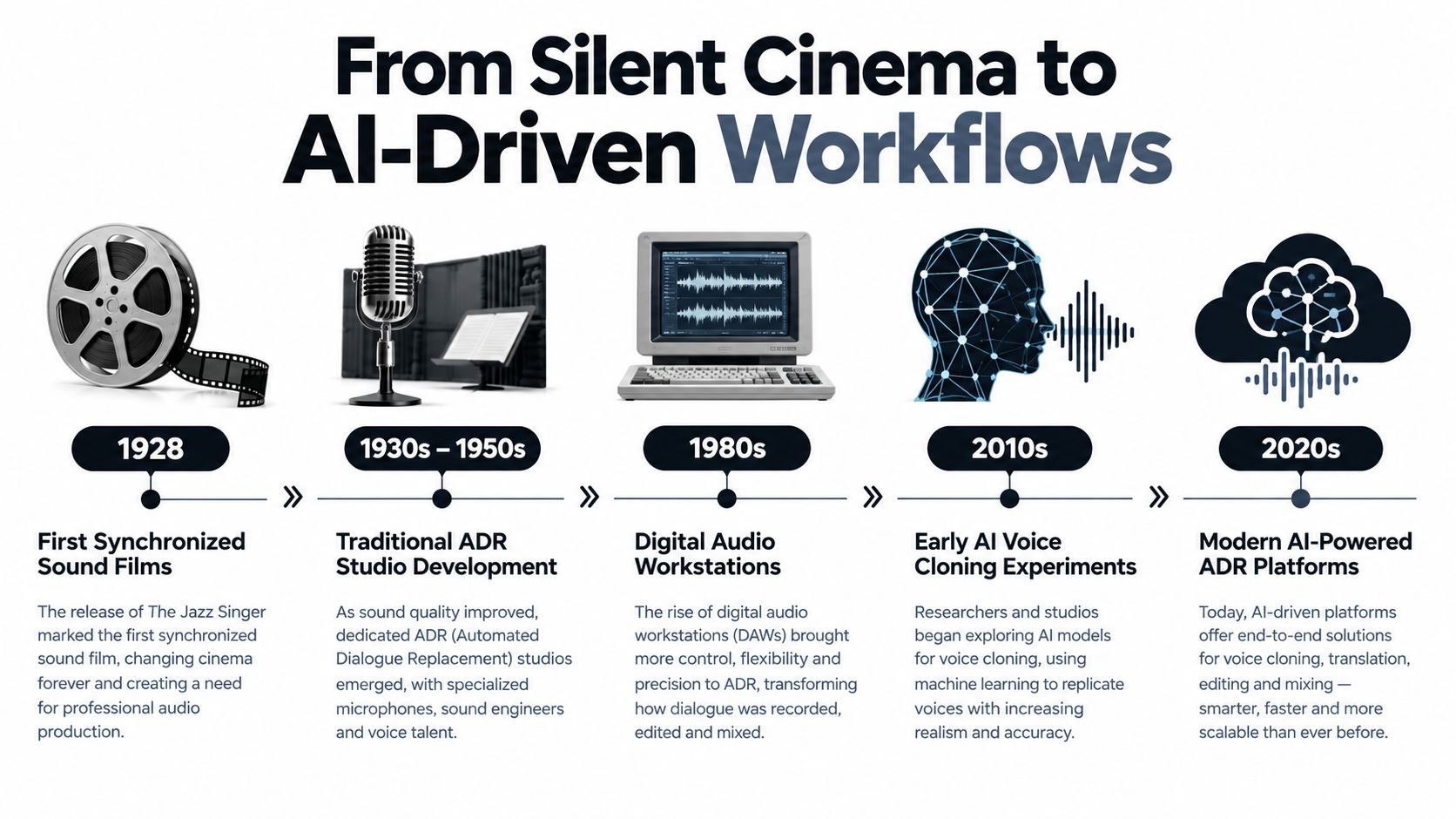
ADR didn't begin with artificial intelligence. Its roots reach back to the change from silent cinema to synchronized sound. By at least 1928, filmmakers were already using post-synchronization to add dialogue to pictures originally shot as silent films, as documented in this history of automatic dialogue replacement.
The early process became known as looping. A short section of film and its soundtrack played repeatedly while actors re-recorded lines to match the filmed performance. By 1935, looping was reportedly used throughout Hollywood, which turned post-production dialogue replacement into a regular studio practice rather than an unusual repair.
The workflow stayed stable while the tools changed
The essential task has remained remarkably consistent:
- Identify dialogue that needs attention.
- Record or construct a replacement.
- Align it to the image.
- Blend it with room tone, perspective, and the surrounding mix.
The equipment changed dramatically. In Los Angeles, Glen Glenn Sound installed a working replacement system between 1967 and 1968 that avoided physical film and soundtrack loops. In 1968, Magna-Tech introduced an electronic looping system that combined a projector, recorder, and controller. The abbreviation ADR formally stood for “Automatic Dialogue Replacement” by 1969, while the process was also known as electronic post-synchronization.
Digital systems developed during the 1980s introduced time-stretching and compression that could adjust duration with little or no audible pitch change. That made it easier to fit a replacement line into the timing of a shot, but timing remained more complex than just matching the total length of two files.
For a practical foundation in recording, editing, and shaping production sound, study the broader principles in this guide to film sound design. Modern AI extends the same workflow by analyzing voices, separating sound sources, and using visual information to guide synchronization. It doesn't erase the historical craft. It accelerates parts of it.
Traditional ADR vs AI-Powered ADR
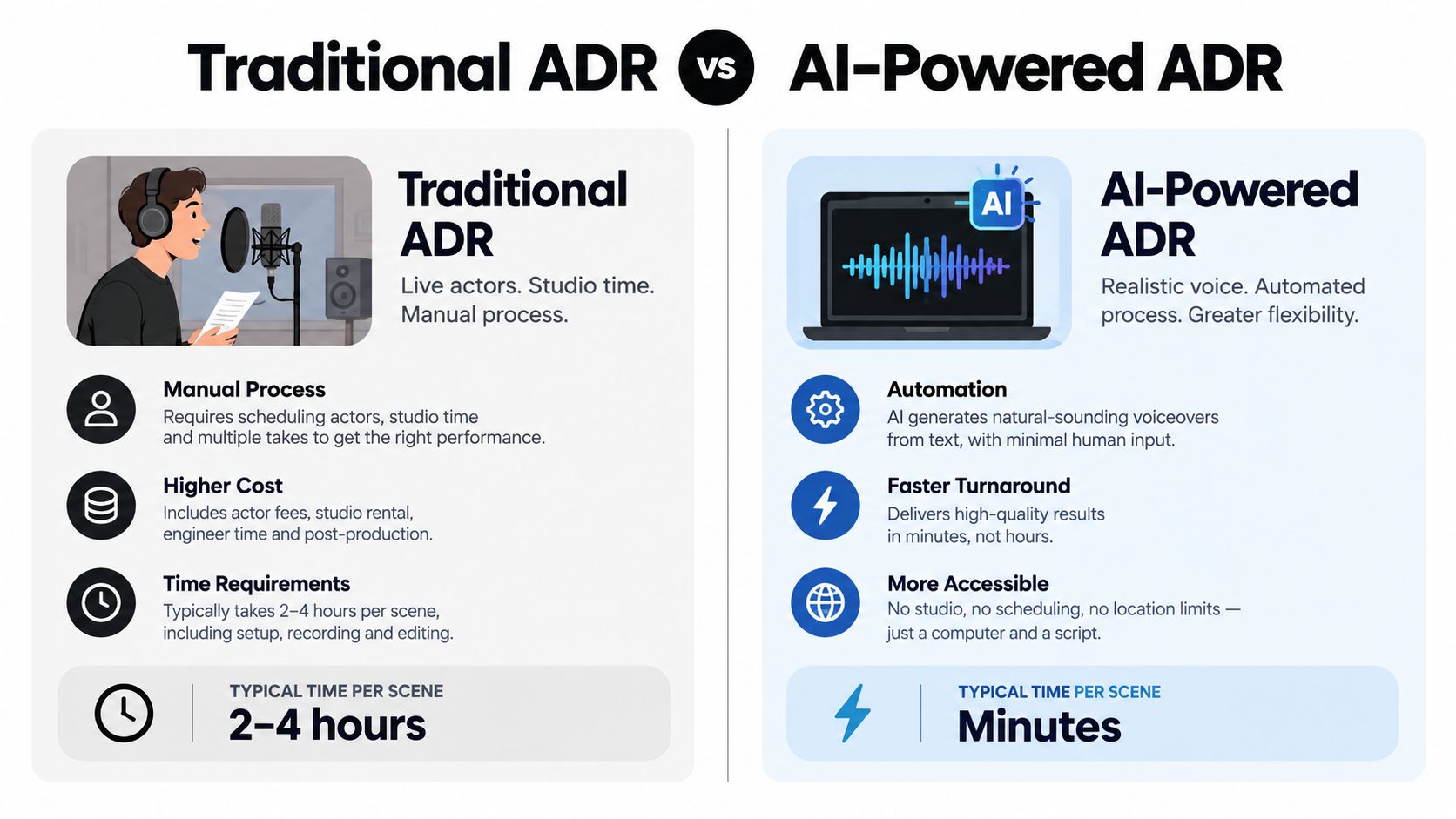
Traditional ADR gives the actor direct control over the replacement performance. The performer watches the image, hears a guide, repeats the line across several takes, and adjusts delivery until the words fit both the face and the scene. A dialogue editor then selects, trims, aligns, processes, and mixes the result.
AI-powered ADR changes where the labor happens. A system may isolate the original speech, adapt timing, synthesize a permitted voice, or propose a replacement that an editor can refine. That can help with temporary tracks, short repairs, localization tests, and lines that need to be evaluated before scheduling a studio session.
What each approach handles well
| Approach | Strengths | Limitations |
|---|---|---|
| Human ADR | Preserves intentional performance choices, emotional nuance, breath, and improvisational control | Requires actor availability, a suitable recording environment, editorial time, and a careful mix |
| AI-assisted ADR | Speeds up isolation, experimentation, timing adjustments, and temporary replacement work | Can produce unnatural prosody, mismatched room perspective, incorrect pauses, or an unauthorized voice likeness |
The choice depends on the problem. If the actor's original intention is valuable but one word is obscured, restoration or a partial repair may be safer than replacing the whole sentence. If a late script revision changes the wording, a permitted synthetic voice can help create a timing reference, but the final release may still call for human approval or a new performance.
AI is also useful before a recording session. An editor can test whether a translated line fits the shot, identify difficult phoneme sequences, and prepare a guide for the actor. That makes the technology a planning instrument as much as a replacement instrument.
Listen for the performance before judging the technology. A technically aligned line can still fail if its emotion, breath, microphone perspective, or room character doesn't belong in the scene.
How to Use Isolate Audio for Dialogue Replacement
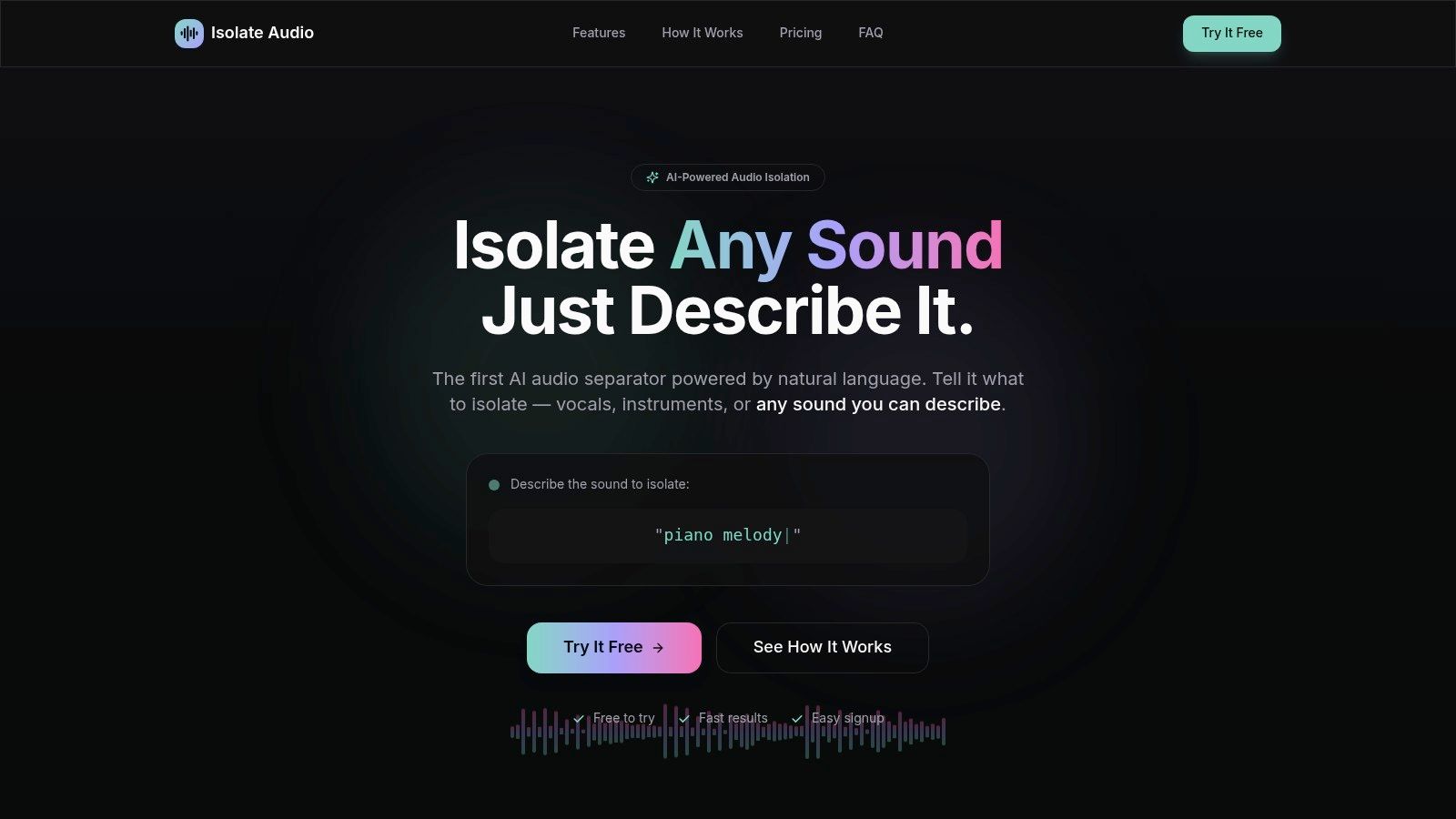
Start with the source, not the replacement. If the production file contains dialogue mixed with music, crowd sound, or location noise, isolate the speech first so you can determine whether the original performance is recoverable.
A practical preparation sequence
- Choose the best available file. Use the cleanest export you have, preferably one that preserves the original production mix rather than a heavily compressed social-media version.
- Upload the audio or video. Isolate Audio accepts common formats such as MP3, WAV, FLAC, M4A, OGG, MP4, and WebM.
- Describe the target sound in plain language. A prompt such as “isolate spoken dialogue” tells the system what you want separated. For a complicated scene, describe the competing element too, such as “remove crowd noise while keeping the actor's speech.”
- Select a quality setting. Use a faster setting for an initial decision and a higher-quality setting when you're preparing material for detailed editing. Precision Mode is intended for difficult mixes with overlapping sources.
- Download both outputs. Keep the isolated element and the remainder. The remainder can preserve ambience or music that helps you judge whether a later replacement will fit.
For a more focused walkthrough, see this guide on how to separate dialogue from music. Compare the isolated speech with the original in context. Listen for consonants, breaths, room tone, and any musical or environmental residue that might confuse your replacement decision.
The next stage is editorial. Place the isolated dialogue under the picture, mark the words that remain usable, and compare them with the full production track. Don't assume that an isolated stem should replace the original automatically. It may work as a repair source, a guide for a human ADR session, or a reference for a synthetic pass.
After isolation, align any replacement against the actor's mouth movements and the original pauses. Add room tone and matching ambience before evaluating the result on headphones and speakers. A dry, clean line can sound less believable than a slightly imperfect one if the scene has a strong acoustic identity.
Quality Considerations and Metrics
A replacement dialogue track must pass two separate tests. It should sound like a credible performance, and it should look as if the voice comes from the speaker on screen. A line can succeed at one and fail at the other, much like a recording can have clean tone but poor timing.
Automated dubbing research often measures Lip Sync Error Distance, or LSE-D, and Lip Sync Error Confidence, or LSE-C. These SyncNet-style metrics estimate audio-visual alignment. Lower LSE-D and higher LSE-C generally indicate better synchronization, as described in this FlowDubber research paper. The Chem benchmark reported absolute improvements of 5.63% in LSE-C and 5.65% in LSE-D over the previous state-of-the-art dubbing method. Its authors connected those gains with semantic-aware learning and dual contrastive alignment.
What the metrics miss
A strong score cannot confirm that the line feels human. Automated checks may miss whether:
- The emotional peak arrives at the correct moment.
- A breath appears where the original actor breathes.
- A plosive looks and sounds natural at visible mouth closure.
- The replacement matches microphone distance and room response.
- A pause leaves room for another actor's reaction.
Duration alone also gives an incomplete picture. A line may occupy the correct total time while placing silence boundaries incorrectly. Voice activity works like a timing map, marking where speech starts, stops, and leaves space. Recent lip-synchronous dubbing research describes conditioning speech synthesis on voice activity to follow source timing and preserve more natural pauses, as explained in this study of voice-activity-aware dubbing.
Use metrics as screening tools, then review the scene manually. Watch close-ups, listen for consonant alignment, compare the emotional contour, and test the mix with surrounding ambience. For production acceptance, combine objective sync checks with human review of intelligibility, prosody, vocal identity, and acoustic continuity, a workflow this guide to AI dialogue cleaning covers in detail. Isolate Audio can support the cleanup stage by helping you judge whether the original track needs repair before replacement. A technically close line still needs to belong to the shot.
Restoration vs Replacement - A Decision Framework
A damaged recording doesn't automatically justify full replacement. Restoring the original can preserve the actor's exact timing, breath, vocal texture, and interaction with other performers. Replacing the entire line may produce clearer words while removing the qualities that made the take work.
Use a narrow intervention first:
- Preserve the original when the words are intelligible and the performance carries the scene.
- Repair the damaged portion when noise affects only a word, consonant, or short phrase.
- Blend isolated speech with the production track when separation improves clarity but leaves useful ambience behind.
- Record human ADR when the original cannot be recovered and the performance needs expressive control.
- Use synthetic dialogue cautiously for authorized temporary tracks, permitted voice use, or script changes that have passed editorial and rights review.
This framework changes the question from “Can AI generate the sentence?” to “What part of the original must survive?” That distinction protects realism. A replacement can match words and approximate timbre while losing microphone perspective, room reflections, breath placement, or the actor's response to a scene partner.
For production teams comparing external support, directories of video editing companies can help identify editors with dialogue cleanup, ADR preparation, and final-mix experience. Ask prospective collaborators how they preserve original performances, document synthetic processing, and handle approvals.
Minimal intervention is often the most convincing intervention. Repair the smallest damaged element that solves the storytelling problem, then reassess the whole scene.
Best Practices for Multilingual and Complex Projects
Multilingual ADR adds a timing problem that translation alone can't solve. Languages differ in speech duration, syllable structure, and phoneme sequences, so a direct translation may be semantically correct but visually awkward. Compressing it to fit can force an unnatural speaking rate.
A reliable multilingual workflow includes:
- Translate for meaning and performance. Ask a native-speaking editor or dialogue adapter to preserve intent, register, character voice, and scene rhythm.
- Check the shot before recording. Mark visible mouth closures, pauses, reactions, and cuts. These moments matter more than matching a line's total duration.
- Adapt phonemes to the image. Where possible, choose words whose mouth shapes and stress pattern cooperate with the original performance.
- Review the complete scene. Native speakers should assess pronunciation, emotional credibility, cultural fit, and intelligibility, not just literal accuracy.
The engineering and rights workflows must develop together. If a system uses voice cloning, record who authorized the voice, what material may be generated, how compensation is handled, and whether audiences need disclosure. Keep correction and takedown procedures clear before release.
Guides that help teams create multilingual videos easily can be useful for planning localization, but automation shouldn't remove native-speaker review or performer consent. Treat every generated line as an editorial asset with a source, permission status, language review, and version history.
For complex projects, preserve the original production audio, isolated dialogue, replacement takes, room tone, translations, cue sheets, and approvals as separate, clearly labeled assets. That organization makes revisions safer and lets a mixer restore the original when a synthetic choice doesn't hold up in context.
Isolate Audio separates a described sound from a recording and returns the isolated element alongside the remainder, which can help editors prepare dialogue for restoration or replacement. Upload a scene, describe the speech or competing sound you need to isolate, and visit Isolate Audio to test the workflow on your own footage.