API Access Control: Securing Isolate Audio Integrations
95% of reported API attacks targeted authenticated sessions, and BOLA accounted for 27% of those attacks in a 2025 industry dataset. For Isolate Audio, that means the primary security challenge isn't only keeping attackers out, it's stopping one customer from downloading another customer's isolated stems.
You've probably already protected the obvious boundary. The API validates a bearer token, rejects expired credentials, and checks whether the caller is a known customer. Then an otherwise ordinary request arrives for /outputs/8f..., and the caller changes the identifier to another valid output ID. If the service returns the file, authentication worked exactly as designed. Authorization failed.
That distinction matters for any SaaS audio platform handling vocals, instrument stems, raw recordings, podcast interviews, research files, and generated outputs. A valid identity proves who is calling. It doesn't prove which object that identity may read, modify, delete, or download.
The Hidden Danger in Your Audio API
A remix artist uploads a track, starts an isolation job, and receives a job identifier. Later, the artist requests the vocal stem:
GET /v1/outputs/job_abc123/vocals.wav
The API validates the access token, identifies the customer, and returns a signed download URL. The route appears protected because the token is valid and the request is well formed.
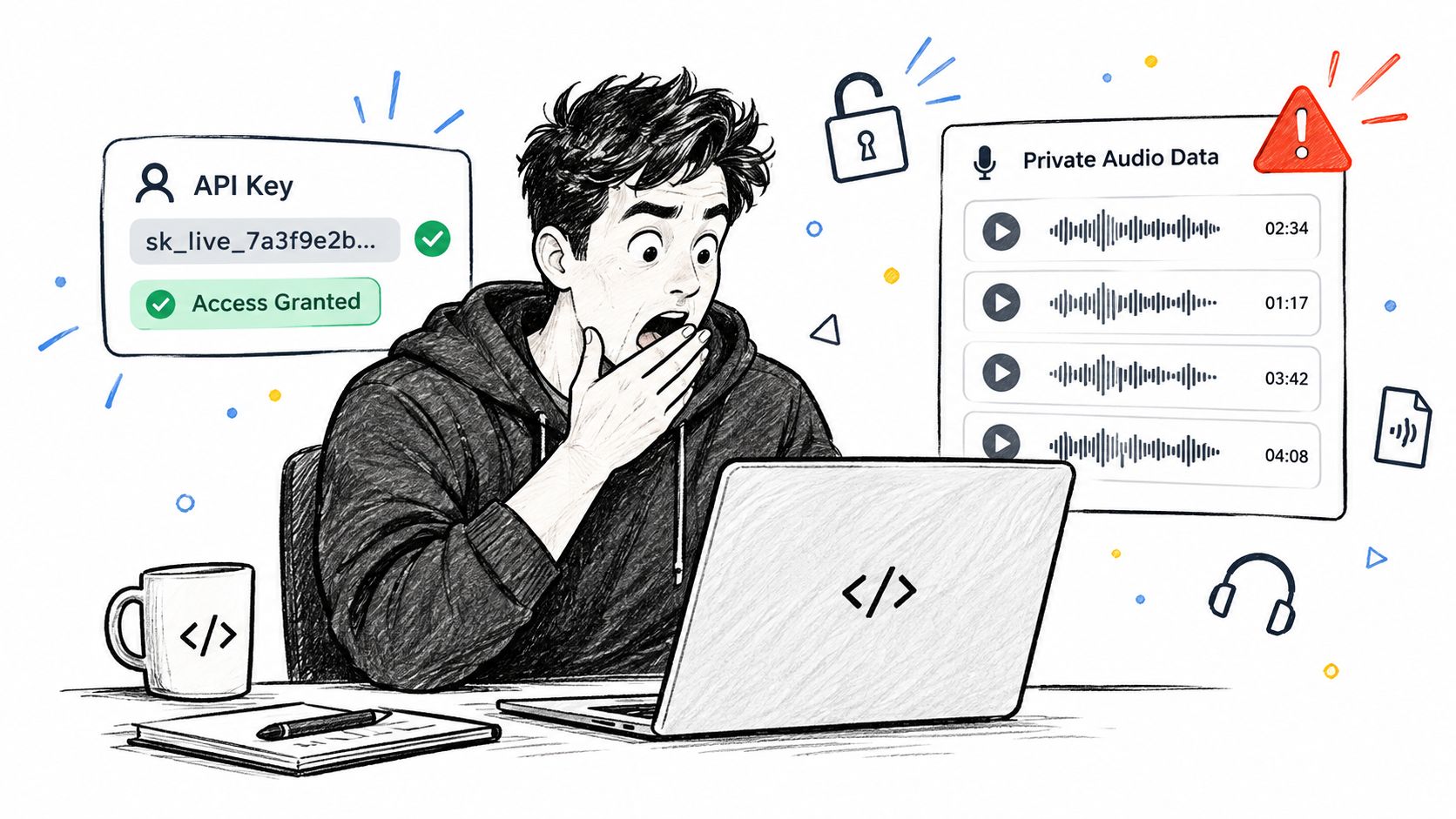
An attacker does not need to break authentication. The artist can replace job_abc123 with an identifier copied from another response, browser history entry, or leaked log. If the handler queries the job by ID without verifying its owner, the artist receives another customer's private recording. This is an insecure direct object reference, commonly called Broken Object Level Authorization, or BOLA.
Authentication answers only half the question
Authentication answers, “Who is this caller?” It can use a session, API key, OAuth access token, service identity, or signed request. Authorization answers a separate question: “May this caller perform this action on this particular resource?”
Keep those decisions separate in the implementation. A token with jobs:read may let a customer inspect the status of its own processing jobs. It must not grant access to every job in the database. Likewise, outputs:download should identify an allowed operation, not provide universal access to every output.
The distinction matters because 95% of reported API attacks targeted authenticated sessions, and BOLA represented 27% of those attacks in a 2025 industry dataset documented by the 2025 API threat report. A stronger login flow cannot correct an endpoint that trusts a client-supplied object ID.
Practical rule: Treat every resource identifier in a request as untrusted input, even after the token has been validated.
For an audio service such as Isolate Audio, protected objects include uploaded files, source videos, separation jobs, isolated elements, remainder tracks, billing records, and workspace assets. One missing ownership predicate can expose creative work or sensitive research material without producing an authentication alert.
Why endpoint protection isn't enough
Route-level checks are only the first layer:
GET /jobsrequires a user token.GET /outputs/{output_id}requires theoutputs:downloadscope.DELETE /uploads/{upload_id}requires an authenticated account.
The handler still has to evaluate principal, tenant, object, and action together. It must verify that the output belongs to the caller's tenant and that the requested operation is permitted for that object. In practice, enforce that relationship in the data query or service layer, rather than relying on a later controller check. A valid identity and valid scope do not establish ownership.
How API Access Control Evolved
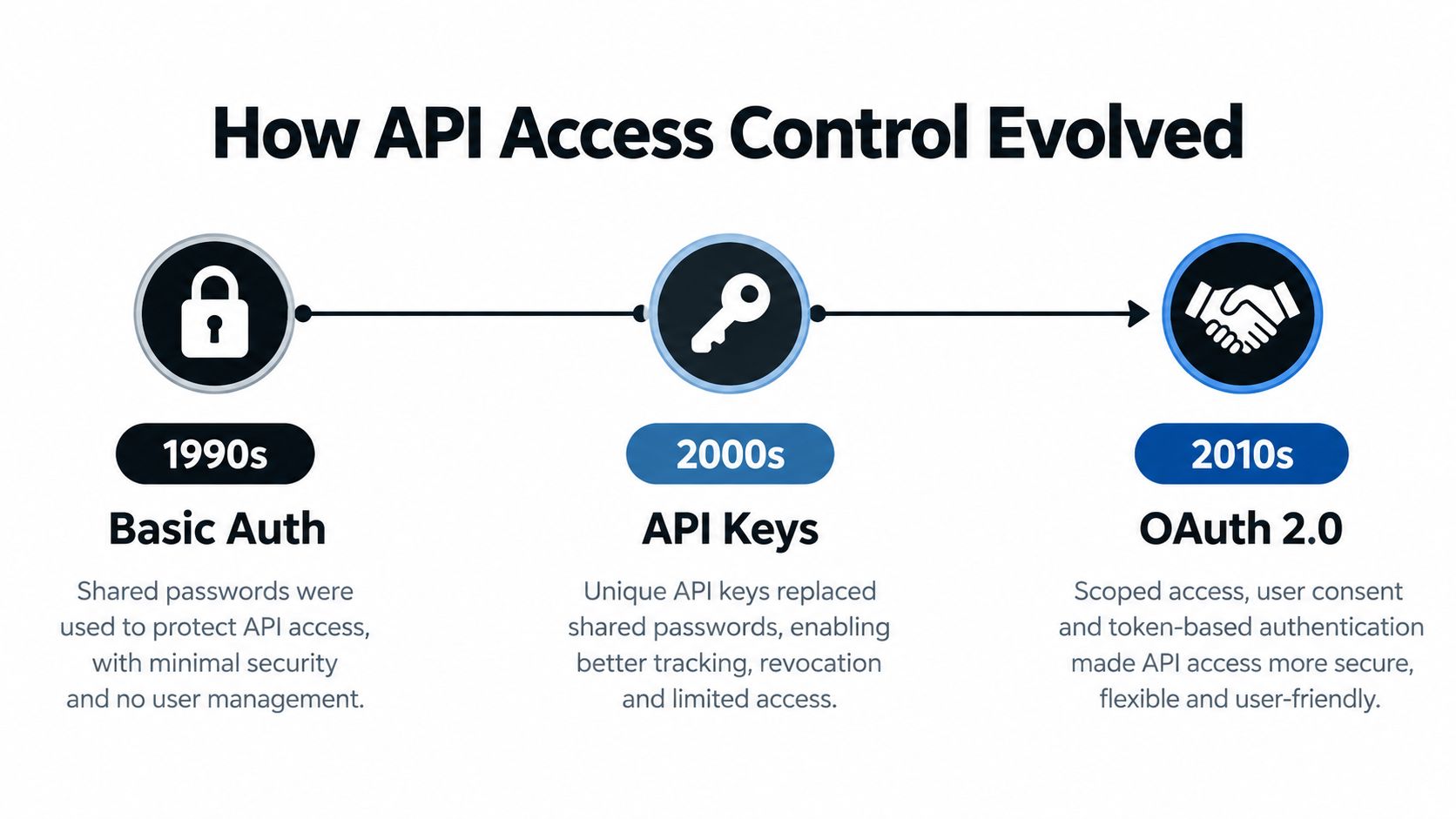
Early integrations often treated credentials as proof of both identity and authority. A third-party application received a username and password, or a broad API key, and the server had little context about which actions the application needed. Revoking one integration could require changing a shared password or invalidating a credential used by unrelated systems.
That model was convenient, but it created a large blast radius. An audio editor might need to submit uploads and retrieve completed jobs, while a billing service might need invoice access and nothing else. A single unrestricted credential can't express that difference cleanly.
OAuth introduced delegated permissions
OAuth 2.0 became a formalized web standard when the IETF published RFC 6749 in October 2012. The framework allowed a third-party application to obtain limited access to an HTTP service on behalf of a resource owner, without receiving that user's password, as described in the OAuth 2.0 standardization history.
That shift matters because OAuth separates delegation from credential sharing. A customer can approve an integration, and the authorization server can issue a token with defined scopes, an audience, an expiry, and a client context. The integration receives authority designed for its task rather than permanent access to the customer account.
For an audio-processing API, a useful scope vocabulary might include:
uploads:write, to submit source media.jobs:read, to inspect processing status.outputs:download, to retrieve permitted results.billing:read, to inspect usage or invoices.
These scopes are useful boundaries, but they aren't complete authorization. outputs:download still doesn't answer whether the caller owns a particular output. The resource server must combine token claims with server-side policy and object relationships.
What API keys still do well
API keys aren't automatically useless. They can work for tightly controlled machine-to-machine integrations when the provider can assign each key a narrow identity, rotate it safely, record its use, and enforce permissions server-side. They become dangerous when teams treat possession of the key as permission to perform every operation against every tenant.
OAuth also isn't a security shortcut. It standardizes delegated authorization, but the application still needs to validate issuer, signature, audience, expiry, and scopes. It must protect tokens in storage and transit, handle revocation, and apply authorization checks to the requested resource. The standard provides a foundation. Your service code determines whether that foundation supports a safe building.
Choosing Between RBAC and ABAC Models
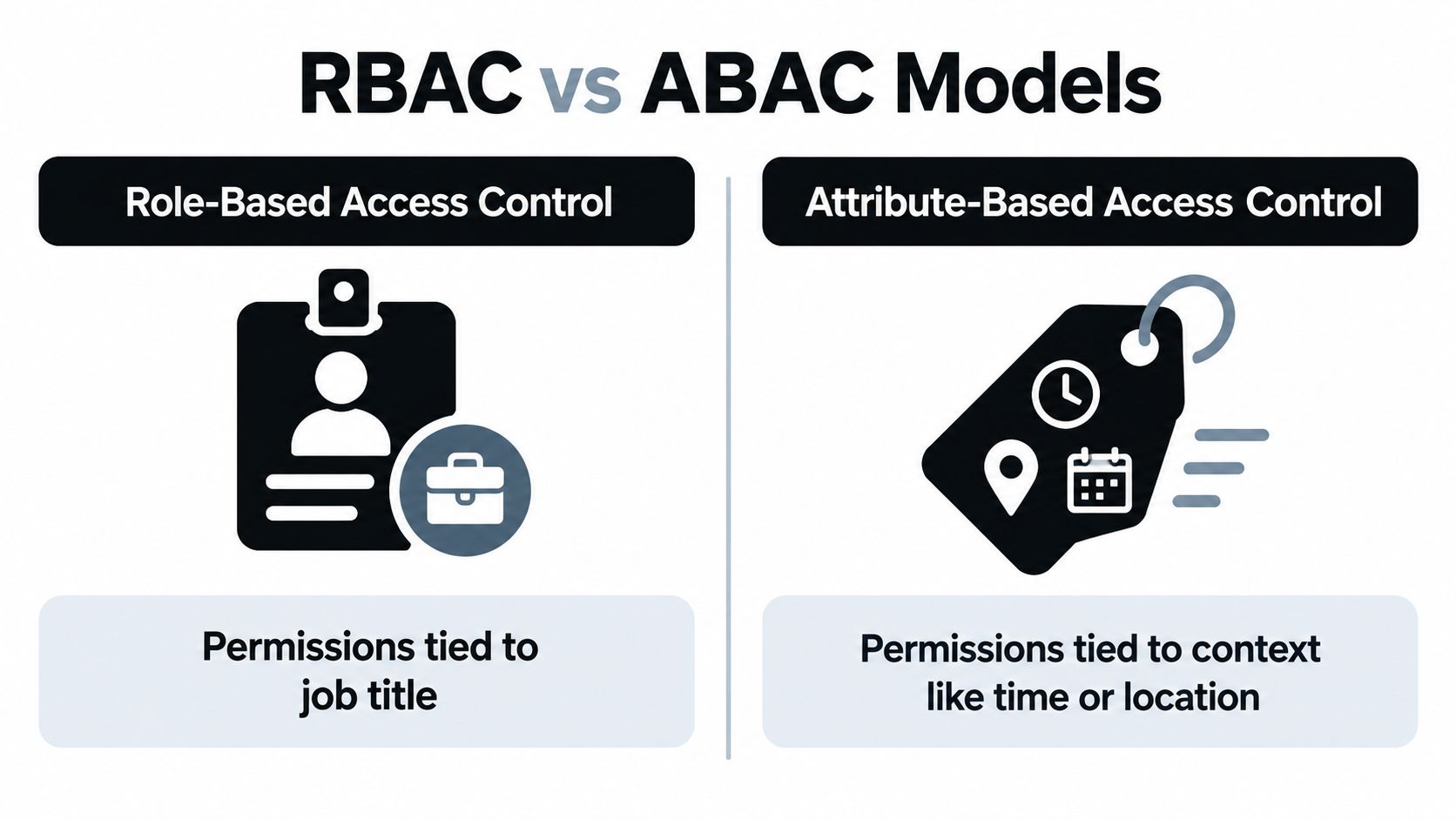
RBAC assigns permissions to roles. A musician, podcast editor, enterprise researcher, and workspace administrator can each receive a role with a defined set of capabilities. This approach is easy to explain, audit, and operate when permissions align closely with stable organizational responsibilities.
A musician role might submit files and download their own results. A researcher role might access approved workspace assets. An administrator might manage members and usage settings. Role definitions give product and support teams a shared vocabulary, and they work well for broad function-level decisions.
RBAC is clear, but it can become rigid
The difficulty appears when access depends on the resource rather than the job title. Two users can share the same role while belonging to different tenants, projects, or research groups. A role can say that both users may download outputs, but it can't safely decide which output each user may download without additional context.
Role hierarchies can also grow into permission sprawl. Teams often respond to exceptions by creating another role, then another. Before long, the role name no longer explains the effective access. Engineers evaluating a role system should document inheritance, administrative boundaries, and escalation paths. A resource such as role hierarchy details can help teams compare how inherited permissions behave before they encode those assumptions into application logic.
ABAC evaluates context
ABAC, or Attribute-Based Access Control, makes decisions from attributes associated with the principal, resource, action, and environment. A policy might allow a user to download an output when:
- The user's tenant matches the output's tenant.
- The user belongs to the workspace containing the job.
- The output is in a completed state.
- The requested action is permitted for the user's role.
- The request comes through an approved client or service context.
ABAC handles these relationships naturally, but it adds operational complexity. Attributes need trustworthy sources, consistent naming, clear precedence, and observable decisions. If policies depend on stale workspace membership or an incorrectly propagated tenant claim, a well-built policy engine can still produce an unsafe result.
A practical SaaS design usually combines both models. Use RBAC for coarse capabilities, such as whether a principal may create jobs or manage billing. Use attribute and relationship checks for resource decisions, such as whether this caller may access this job, output, field, or workspace.
The important trade-off is not choosing a fashionable acronym. It's keeping authorization understandable enough to review while making it precise enough to protect customer-owned media. Centralize policy evaluation where possible, but keep the resource relationship visible in the decision. A role should help determine what a user can do. It shouldn't replace the ownership check.
Preventing BOLA in Audio Processing APIs
OWASP ranked Broken Object Level Authorization as API1 in its 2023 API Security Top 10. The failure occurs when an endpoint accepts an object identifier without verifying that the caller may access that specific object, as described in the OWASP API security guidance.
For an audio API, object-level checks belong on every operation involving an uploaded asset, job, output, or project. That includes retrieval, replacement, deletion, and download. A valid token must never bypass the relationship between the principal, tenant, object, and requested action.
Put the relationship in the query
The safest pattern is to constrain the data lookup by the caller's security context rather than fetching the object first and checking ownership later.
Conceptually, the service should behave like this:
- Validate the access token and establish the principal.
- Resolve the caller's tenant and workspace context from trusted server-side data.
- Load the requested object using both its identifier and an authorized ownership or tenant predicate.
- Evaluate the requested action, such as read, replace, delete, or download.
- Return the resource only after the policy decision succeeds.
For example, a download service shouldn't execute a query equivalent to “find output by output_id.” It should find the output where output_id matches, the tenant matches the authenticated principal's tenant, and the caller has permission for the requested download action. This reduces the chance that a later code path forgets a separate authorization check.
Centralized policy enforcement helps keep the rule consistent across REST controllers, background workers, signed URL services, and administrative endpoints. A download URL also needs protection. If the API authorizes the initial request but creates a broadly usable URL, the URL becomes a new authorization boundary that requires its own expiry, audience, and resource restrictions.
Use unpredictable identifiers as defense in depth, not as authorization. A UUID can reduce casual enumeration, but it doesn't prove ownership.
Test the identifier, not just the login
BOLA tests should deliberately substitute one user's job, upload, or output identifier into another user's request. Run those tests for every endpoint that accepts a client-supplied object ID, including less obvious routes such as retry, rename, replace, transcript access, waveform preview, and bulk export.
The test should verify both read and write behavior. A caller who can't download another customer's stem also shouldn't be able to delete the source file, restart its processing job, change its metadata, or infer sensitive state through an error response.
| Check Type | Implementation Detail | Why It Matters |
|---|---|---|
| Tenant boundary | Require the object's tenant to match the principal's authorized tenant context. | Prevents cross-customer access in shared infrastructure. |
| Object ownership | Verify the caller's relationship to the specific upload, job, output, or project. | Stops identifier substitution from becoming data disclosure. |
| Action permission | Evaluate read, write, delete, retry, and download separately. | A user may be allowed to inspect a job without modifying it. |
| Field policy | Authorize sensitive fields independently from record access. | Reading a job doesn't automatically permit access to billing or private metadata. |
| Negative testing | Replace identifiers with another user's values in automated tests. | Catches authorization gaps that happy-path tests miss. |
| Audit decision | Record principal, tenant, object, action, result, and policy version without raw media payloads. | Supports investigation while limiting sensitive log exposure. |
An endpoint that returns “not found” for unauthorized objects can reduce resource disclosure, but consistency matters. Apply the same policy across synchronous APIs, asynchronous job workers, object storage callbacks, and admin tools. For audio workflows, the highest-risk path is often the final download because that endpoint may hand out a storage URL after the application has already forgotten the original authorization context.
For teams building extraction workflows, audio extraction tools illustrate the kind of output-oriented API surface that needs these checks. Every generated file should remain bound to the authorized source job and tenant throughout its lifecycle.
Token Lifecycle and Rate Limiting
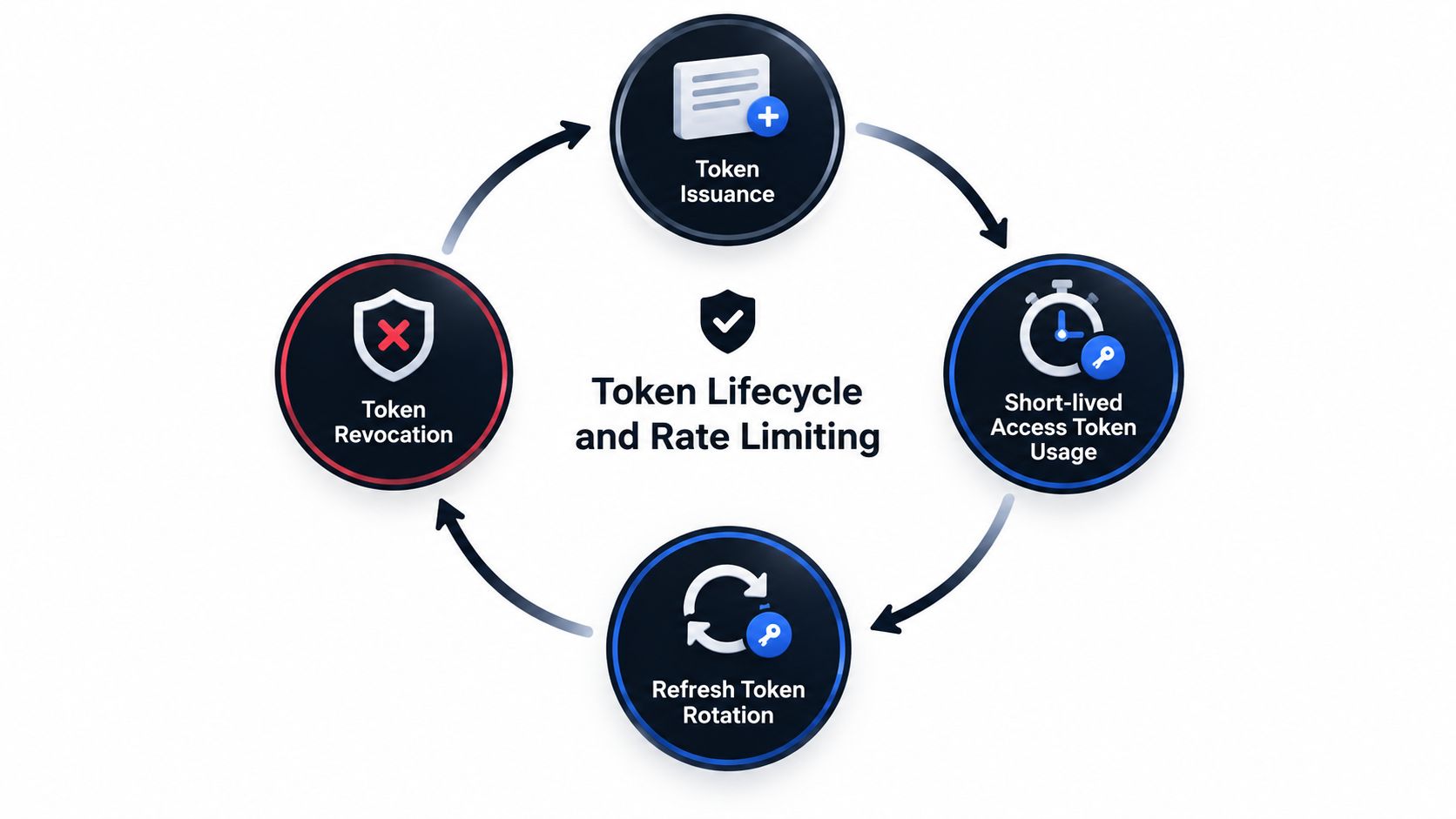
Token issuance is only the beginning of API access control. A production system needs to decide how tokens are created, where they're accepted, how quickly they expire, how they're revoked, and what happens when a client behaves abnormally.
Use short-lived access tokens for routine API calls, with refresh token rotation where the client needs a longer session. Validate the issuer, signature, audience, expiry, and relevant claims at the resource server. For sensitive operations, add stronger authorization or step-up authentication rather than assuming that a token valid for a low-risk read should also authorize deletion or billing changes.
Match limits to the operation
Rate limiting complements authorization, but it doesn't replace it. A limit can slow identifier probing or bulk scraping, yet a caller can still access private data if the object check is missing. Apply limits by principal, tenant, client, operation, and possibly resource type, while accounting for legitimate audio-processing workloads that may involve large uploads and asynchronous polling.
Different actions deserve different treatment:
- Upload creation can use quotas based on account or tenant capacity.
- Job-status polling can allow predictable automation while discouraging tight loops.
- Output downloads can detect repeated access patterns and unusual cross-object attempts.
- Billing reads and administrative mutations should have stricter limits and stronger alerts.
Don't make rate limits so coarse that a noisy upload blocks unrelated security operations for the same customer. Conversely, don't rate-limit only by IP address. Shared networks, workers, and enterprise gateways can make IP-based controls inaccurate, while a stolen token can operate from a normal address.
Make decisions observable
NIST guidance emphasizes secure API design and management, and OAuth 2.0 supports delegated authorization without exposing user passwords to client applications, as summarized in API security standards guidance. The operational requirement is straightforward: log the decision context needed to investigate it.
Record the principal, tenant, object, action, decision, and policy version. Add a correlation identifier and client identity where useful, but avoid writing source audio, isolated stems, raw prompts, or full sensitive payloads into ordinary logs. A sequence of denied requests involving unrelated job IDs can be more valuable than a payload dump, especially when the system can connect those denials to the same token or integration.
Teams documenting key issuance, rotation, and developer onboarding can also use developer tools in DOM Studio as a reference point for the surrounding integration experience. The security objective remains the same: make credentials narrow, attributable, replaceable, and easy to revoke.
Best Practices for Securing Integrations
A production integration should deny access unless the service can make an explicit decision from trusted context. Authentication identifies the caller. Authorization determines which tenant, object, field, and operation that caller may use. Treating those as the same check is how an authenticated request reaches another customer's audio job.
A 2025 study of 68 organizations found that 84% had API defenses substantially below the level required by the sensitivity of their exposed data, while 57 organizations, about 84%, still relied on bare API keys or basic OAuth credentials. Only 10% had an API-security posture-governance strategy, according to the study's published findings. Unlike attack-distribution data, these findings show why BOLA succeeds in practice: authentication and credential management can exist without consistent governance over resource access.
A workable implementation sequence
- Inventory every object endpoint. Include uploads, jobs, outputs, projects, workspaces, usage records, and administrative resources. Record every identifier clients can submit.
- Define actions explicitly. Separate read, create, replace, retry, delete, download, export, and billing operations.
- Map broad permissions to scopes or roles. Keep scopes understandable, while leaving ownership decisions to resource-level policy.
- Bind resources to tenants server-side. Derive tenant context from the authenticated principal instead of trusting a tenant ID in the request body.
- Centralize policy checks. Apply the same authorization logic in controllers, workers, storage callbacks, signed-download creation, and internal services.
- Test horizontal access. Swap object identifiers between test users and confirm that every object-addressing route denies the request.
- Rotate and retire credentials. Give human users, customer integrations, CI/CD jobs, and internal services separate identities and permissions.
- Monitor decisions. Alert on repeated denials, cross-tenant identifier attempts, unused permissions, and unusual download activity.
Review the wider integration environment with cloud app permission checklists, then verify the audio API's object relationships directly. A checklist cannot replace a database query or policy evaluation that enforces tenant ownership.
Privacy documentation should describe how uploaded media, generated outputs, job metadata, and access records are handled. Keep those commitments aligned with the platform's privacy policy. Authorization and data governance must agree, because users need both clear handling rules and technical controls that prevent unrelated customers from retrieving their files.
Start with the most exposed path, often output downloads, and apply the same authorization model to uploads, jobs, previews, retries, and deletion. Isolate Audio provides natural-language audio separation, cloud processing, generated isolated and remainder outputs, API access, and custom integrations. Visit Isolate Audio to evaluate the workflow, then verify that every token, object ID, and download request receives an explicit authorization decision.